Adding a hot tub to your Arkansas property is an exciting investment that promises relaxation, therapeutic benefits, and increased home value. However, before you can enjoy bubbling water under the stars, you must address a critical foundation question: what are the hot tub concrete pad requirements in Arkansas? The answer involves more than just pouring a slab. It requires understanding local soil conditions, frost depth regulations, and proper drainage techniques. A poorly planned pad can lead to cracked concrete, uneven settling, and even damage to your expensive hot tub. Let’s explore exactly what you need to know to build a durable, code-compliant foundation for your hot tub in the Natural State.
Why a Concrete Pad is Essential for Your Hot Tub
A hot tub is heavy. When filled with water and occupants, a standard 6-person model can weigh over 3,000 pounds. That kind of load requires a stable, level surface that can distribute weight evenly across the soil. A concrete pad provides this stability far better than gravel, pavers, or wooden decks. In Arkansas, where clay soils are common and freeze-thaw cycles occur, a properly designed concrete pad prevents your hot tub from sinking, tilting, or developing structural stress. Without a concrete pad, you risk voiding your hot tub warranty, facing costly repairs, and creating an unsafe condition for users.
Hot Tub Concrete Pad Requirements Arkansas: Key Factors
The specific requirements for a hot tub concrete pad in Arkansas depend on several factors including your location, soil type, and the size of your hot tub. However, most installations follow a standard set of best practices that ensure long-term performance.
Minimum Thickness and Reinforcement
The concrete pad for a hot tub should be at least 4 inches thick. For larger hot tubs or those placed on softer soils, 5 to 6 inches is recommended. Reinforcement is critical. Use welded wire mesh or rebar placed in the center of the slab to prevent cracking. In Arkansas, where ground movement from moisture changes is common, reinforcement helps the slab stay intact. A 6×6 inch wire mesh with 10-gauge wire is standard, but rebar at 18-inch intervals offers even greater strength.
Consider this: a typical 8×8 foot hot tub pad requires roughly 2.5 cubic yards of concrete. That much concrete weighs approximately 10,000 pounds. Without reinforcement, the slab can crack under the combined weight of the concrete and the hot tub. Professional concrete contractors in Batesville and surrounding areas understand these dynamics and will specify the right mix and reinforcement for your project.
Slope and Drainage Requirements
Your hot tub concrete pad must have a slight slope for drainage. A 1/8 inch per foot slope is standard, directing water away from the pad and the hot tub equipment. In Arkansas, where heavy rainfall is common, proper drainage prevents water from pooling under the hot tub, which can cause rust, mold, and foundation erosion. The pad should also extend at least 6 inches beyond the hot tub footprint on all sides to provide a stable walking surface and prevent soil from washing out from underneath.
In our guide on concrete pad for shed preparation drainage Arkansas, we explain how proper grading and gravel base layers are essential for any outdoor concrete foundation. The same principles apply to hot tub pads. A well-prepared base with 4 to 6 inches of compacted gravel beneath the slab ensures water drains away and the concrete remains stable through seasonal changes.
Arkansas Frost Depth Considerations
One of the most overlooked hot tub concrete pad requirements in Arkansas is frost depth. The frost line in Arkansas varies by region but typically ranges from 12 to 24 inches deep. In northern Arkansas, including Batesville, the frost line is closer to 18 inches. Your concrete pad should be poured on a base that extends below the frost line or be designed as a floating slab that can move slightly with frost heave without cracking. A floating slab is thicker at the edges (often 12 inches) and thinner in the center (4 to 6 inches). This design allows the slab to rise and fall uniformly during freeze-thaw cycles, preventing differential movement that causes cracks.
Step-by-Step Process for Building a Hot Tub Concrete Pad
Building a proper concrete pad involves several steps. Skipping any of them can compromise the final result. Here is a reliable sequence to follow.
- Mark and excavate the area. Clear the site of grass, roots, and topsoil. Excavate to a depth of 6 to 8 inches for the gravel base plus the concrete thickness. Make the excavation at least 12 inches wider than the pad on all sides.
- Compact the soil. Use a plate compactor to tamp down the exposed soil. This step is crucial in Arkansas clay soils, which can settle significantly if not compacted properly.
- Add and compact gravel base. Spread 4 to 6 inches of crushed stone or gravel. Compact it thoroughly. This layer provides drainage and a stable working platform.
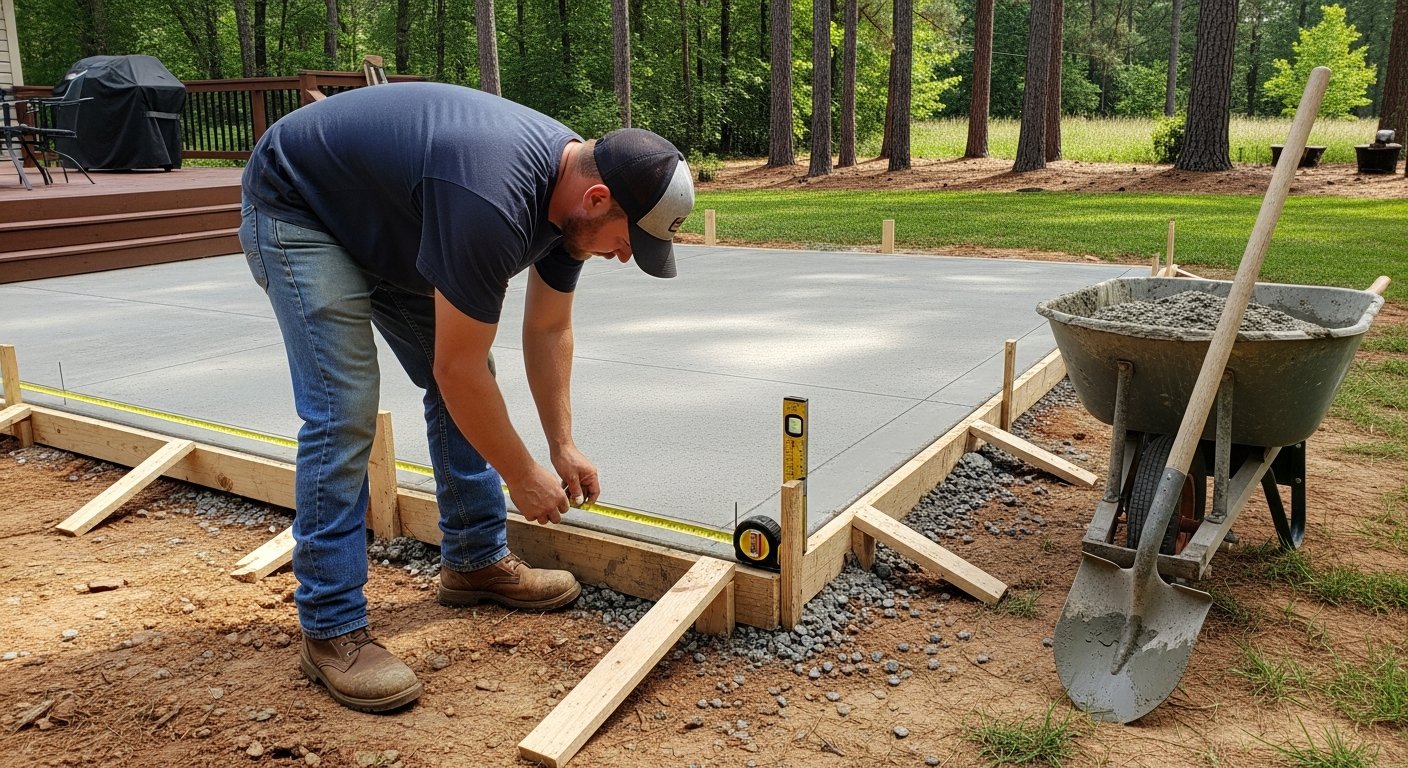
- Install forms and reinforcement. Set up wooden forms to define the pad edges. Level them carefully. Place wire mesh or rebar on supports to keep it in the middle of the slab thickness.
- Pour and finish the concrete. Use a concrete mix with a compressive strength of at least 3,500 psi. Pour, screed, and trowel the surface to a smooth finish. Add a slight slope for drainage.
- Cure the concrete properly. Keep the concrete moist for at least 7 days. In Arkansas summer heat, this may require covering with wet burlap or using a curing compound. Proper curing prevents surface cracks and ensures maximum strength.
After the concrete cures for 7 to 14 days, you can install your hot tub. However, waiting 28 days for full strength is ideal. During this time, keep heavy equipment off the pad.
Permits and Local Codes for Hot Tub Pads in Arkansas
Before breaking ground, check with your local building department. Many Arkansas counties and cities require permits for concrete pads over a certain size or for any electrical work associated with the hot tub. In Batesville and Independence County, permits are typically required for structural concrete work and electrical connections. Your contractor can handle this process, but if you are doing the work yourself, contact the Batesville Building Inspection Department to understand specific requirements. Failing to obtain a permit can result in fines and may complicate future home sales.
Electrical codes are also important. Hot tubs require a dedicated GFCI-protected circuit installed by a licensed electrician. The concrete pad must accommodate the conduit and junction box locations as specified by the National Electrical Code and local amendments. Plan the pad layout with these electrical components in mind to avoid conflicts.
Concrete Pad Size Recommendations for Common Hot Tubs
Choosing the right pad size ensures your hot tub fits comfortably with room for access and maintenance. Here are recommendations based on common hot tub sizes:
- 2-3 person hot tub (60×60 inches): Minimum pad size 7×7 feet. This provides 6 inches of clearance on each side for entry and service access.
- 4-5 person hot tub (84×84 inches): Minimum pad size 9×9 feet. The extra space allows for a small step or equipment access on one side.
- 6-8 person hot tub (96×96 inches): Minimum pad size 10×10 feet. Larger pads are better for these larger units to accommodate multiple entry points.
Always check your hot tub manufacturer’s specifications for minimum pad dimensions. Some manufacturers require a specific pad size to maintain the warranty. The pad should be a minimum of 2 inches larger than the hot tub footprint on all sides, but 6 to 12 inches is more practical for everyday use.
Common Mistakes to Avoid When Building a Hot Tub Pad
Even experienced DIYers can make errors when building a hot tub concrete pad. Here are the most common pitfalls and how to avoid them.
Inadequate base preparation. The most frequent mistake is insufficient gravel base or poor compaction. Arkansas clay soil expands and contracts with moisture. Without a 4-6 inch compacted gravel base, the concrete will crack. Take the time to compact in layers for the best results.
Ignoring slope. A perfectly level pad sounds ideal, but it will trap water. Always include a slight slope away from the hot tub location. This simple step prevents water damage to the hot tub cabinet and reduces slip hazards.
Using the wrong concrete mix. Standard sidewalk mix may not be strong enough. Use a 3,500 psi or higher mix with air entrainment for freeze-thaw resistance. In Arkansas, air-entrained concrete performs better through winter cycles.
Pouring in extreme weather. Arkansas summers are hot and winters can be cold. Avoid pouring concrete when temperatures exceed 90 degrees Fahrenheit or fall below 40 degrees Fahrenheit. Hot weather causes rapid drying and cracking. Cold weather can prevent proper curing.
Cost Estimates for a Hot Tub Concrete Pad in Arkansas
The cost of a hot tub concrete pad in Arkansas varies based on size, thickness, reinforcement, and labor. For a standard 8×8 foot pad, expect to pay between $800 and $1,500 for materials and professional installation. This includes excavation, gravel base, concrete, reinforcement, and finishing. If you need electrical rough-ins or additional site preparation, costs can increase to $2,000 or more. DIY costs are lower, typically $300 to $600 for materials, but require significant labor and equipment rental. Hiring a professional concrete contractor from Batesville ensures the job meets local codes and lasts for decades. When you factor in the cost of your hot tub (often $5,000 to $15,000), investing in a quality concrete pad is a small fraction of the total project cost that protects your larger investment.
Why Hire a Professional for Your Hot Tub Pad?
While building a concrete pad is possible for a skilled DIYer, hiring a professional offers several advantages. Professional contractors understand Arkansas soil conditions, local building codes, and proper reinforcement techniques. They have the equipment to properly grade, compact, and pour the slab efficiently. Perhaps most importantly, they guarantee their work. If the concrete cracks or settles, they will fix it. For a project that supports thousands of pounds of hot tub and water, that peace of mind is valuable. The Real Deal of Batesville provides concrete pouring and finishing services in Batesville, Arkansas, and the surrounding areas. Our team has experience building hot tub pads that meet all local requirements and withstand Arkansas weather for years. We handle the permits, site preparation, and finishing so you can focus on enjoying your new hot tub.
A hot tub concrete pad is not just a flat spot in your yard. It is a carefully engineered foundation that must support significant weight, resist moisture, and survive freeze-thaw cycles. By following the hot tub concrete pad requirements Arkansas homeowners need to know, you ensure your hot tub remains level, safe, and functional for many years. Whether you build it yourself or hire a professional, pay attention to the details: proper base, reinforcement, slope, and curing. Your future self will thank you every time you step into warm, relaxing water without worrying about what lies beneath.