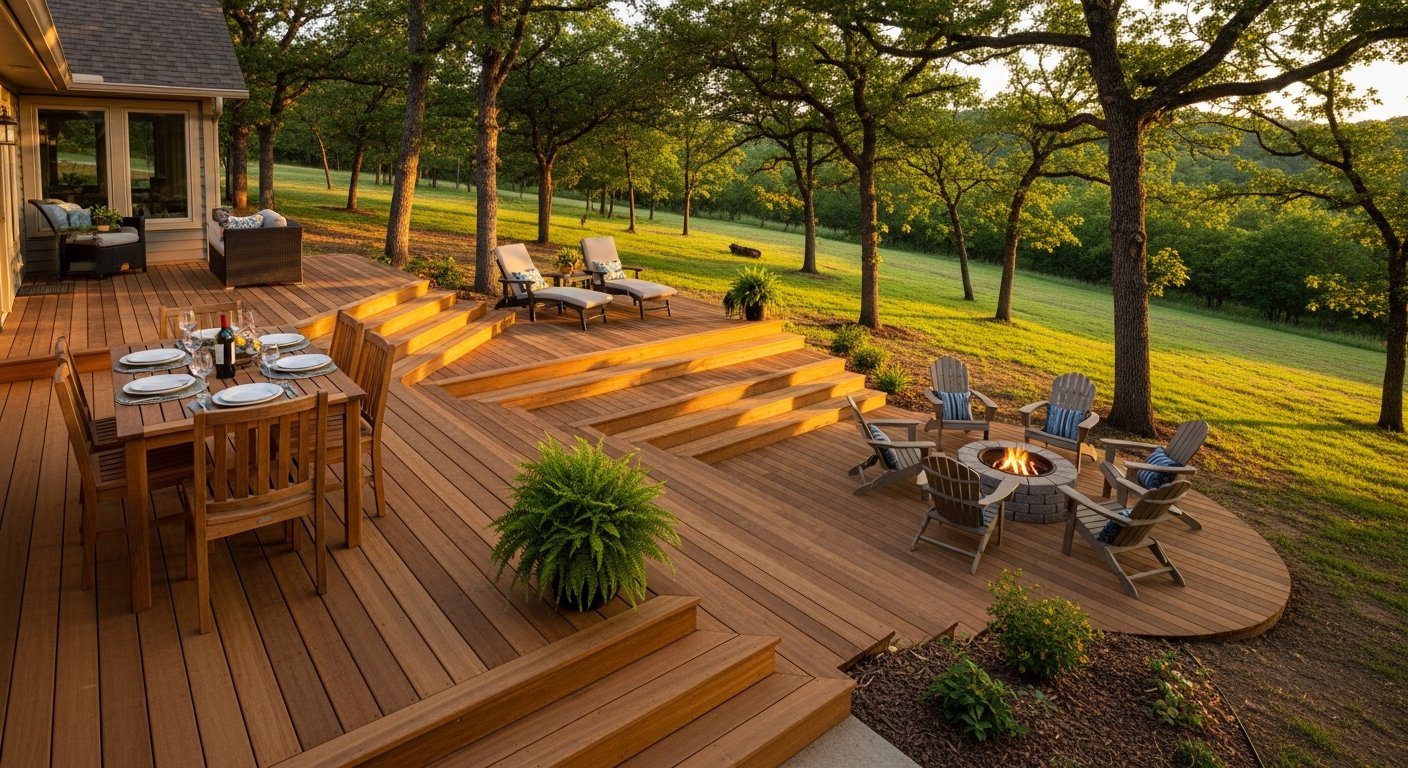
If your Batesville home sits on a sloping lot, you already know the challenge: a steep backyard that feels unusable. But what if that slope could become your home’s greatest asset? Multi-level deck design for sloped yards in Batesville Arkansas transforms awkward terrain into a stunning outdoor living space. Instead of fighting the grade, you work with it. The result is a series of connected platforms that create distinct zones for dining, lounging, and entertaining. This approach maximizes every square foot of your property while adding significant value to your home.
Why Multi-Level Decks Work Perfectly on Arkansas Slopes
Arkansas homeowners face unique challenges with sloped properties. Heavy spring rains cause erosion, and the freeze-thaw cycle can destabilize poorly built structures. A multi-level deck addresses these issues directly. By breaking the deck into separate platforms that follow the natural contour of your land, you reduce the need for massive excavation. Each level can be built at a different height, stepping down the slope gracefully. This method also improves drainage because water flows naturally between the levels rather than pooling on a single large surface.
Another advantage is visual interest. A flat deck on a slope often looks like an afterthought. Multi-level designs, however, create a dynamic, layered appearance that feels intentional and luxurious. In our guide on Multi-Level Deck Ideas for Sloping Yards in Arkansas, we explore how tiered layouts can double your usable outdoor space. For Batesville homeowners, this means you can have a grilling station on one level, a fire pit on another, and a quiet reading nook on a third. Each area feels separate yet connected.
Key Design Considerations for Sloped Lot Decks
Site Analysis and Soil Conditions
Before any design work begins, you need a thorough site evaluation. Sloped lots in Batesville often have clay-heavy soil that expands and contracts with moisture changes. This soil movement can shift deck footings if they are not deep enough. A professional contractor will test the soil and determine the proper footing depth. In many cases, helical piers or concrete footings extending below the frost line are necessary. This upfront investment prevents costly repairs later.
You also need to assess water flow. Where does rainwater travel across your property? A well-designed multi-level deck should not block natural drainage. Instead, it should accommodate water movement with gaps between deck boards and proper grading underneath. Some homeowners add a dry creek bed or French drain system beneath the lowest deck level to manage runoff effectively.
Zoning and Building Permits in Batesville
Batesville has specific building codes for decks, especially those over 30 inches above grade. Multi-level designs often require permits because they involve structural connections between levels. You will need to submit plans showing footing sizes, beam spans, and railing heights. The city may also require a setback from property lines. Working with a local contractor who understands Independence County regulations saves time and frustration. They can pull the necessary permits and schedule inspections at each construction phase.
Keep in mind that decks attached to the house must meet additional requirements for ledger board attachment. Improper flashing at the house connection is one of the most common deck failures. A certified contractor will install proper flashing to prevent water intrusion into your home’s wall system.
Material Selection for Long-Lasting Decks
Choosing the right materials is critical for multi-level deck design in sloped yards Batesville Arkansas. The local climate demands durability. Summers are hot and humid, winters bring freezing temperatures, and spring storms deliver heavy rain. Here are the top material options:
- Pressure-Treated Pine: Affordable and widely available. It resists rot and insects when properly sealed. However, it requires annual staining or sealing to maintain appearance. Best for budget-conscious projects or lower levels that see less foot traffic.
- Composite Decking: Made from wood fibers and recycled plastic. It resists moisture, mold, and fading. Composite does not need staining, but it can get hot in direct sunlight. Darker colors absorb more heat. Ideal for upper levels exposed to full sun.
- PVC Decking: A synthetic material that is fully waterproof. It stays cooler than composite and never rots. PVC is the most expensive option but offers the lowest maintenance. Excellent for ground-level decks or areas near moisture.
- Cedar or Redwood: Naturally resistant to decay and insects. These woods have a beautiful grain but require regular maintenance. They are lighter in weight, which can reduce structural loading on steep slopes.
Each material has trade-offs. For a multi-level deck, you might mix materials. Use composite on the main entertaining level for low maintenance, and pressure-treated wood on lower levels to save money. Your contractor can help you choose the right combination based on sun exposure, traffic, and budget.
Structural Engineering for Sloped Decks
A multi-level deck on a slope requires more engineering than a standard ground-level deck. The lateral forces are greater because the structure must resist the downhill push of soil and gravity. Posts must be securely anchored, and beams must be sized to handle the span between supports. Many contractors use a stepped footing system where each post sits on a concrete pier at a different elevation. This method eliminates the need for long, unsupported posts that can wobble.
Another consideration is lateral bracing. Each level should be braced diagonally to prevent racking. In high-wind areas like Arkansas, this is especially important. The connection between the house and the deck must also be robust. A double ledger board with through bolts is standard for attached decks. For freestanding multi-level decks, the entire structure relies on its own posts and footings, which must be designed to resist overturning.
Handrails and guardrails are another critical element. For decks over 30 inches high, codes require rails at least 36 inches tall. On a multi-level deck, you may need rails around each level, especially where there is a drop-off between platforms. Cable railing is a popular choice because it provides safety without blocking views of your yard.
Creating Functional Zones Across Levels
The beauty of a multi-level deck is the ability to create distinct outdoor rooms. Here is how to plan each level for maximum usability:
Upper Level: This is typically the main entry point from the house. It should be large enough for a dining table and chairs. Position it for easy access to the kitchen for serving food. Include a built-in grill station or countertop for outdoor cooking. If you have a covered patio area, this is the level to place it.
Middle Level: A step down from the upper level, this zone works well for lounging. Add comfortable seating, a fire pit, or a conversation area. The transition between levels can be a short staircase or a wide set of steps that double as extra seating. Consider adding a pergola or shade structure over this level for afternoon comfort.
Lower Level: This level is closest to the yard. It is ideal for a hot tub, a children’s play area, or a vegetable garden. Because it is closer to the ground, you can incorporate planters or retaining walls that blend the deck into the landscape. This level often connects to a lawn or pathway.
Stair placement is crucial. Avoid long, straight staircases that feel like a chore to climb. Instead, use wide, gently curving steps or landings that break up the vertical distance. Lighting along stair treads improves safety and adds ambiance for evening gatherings.
Budgeting for Your Multi-Level Deck Project
The cost of multi-level deck design for sloped yards in Batesville Arkansas varies widely based on size, materials, and site conditions. A typical project ranges from $15,000 to $40,000 or more. Here are the factors that influence price:
- Size and Number of Levels: More levels mean more footings, framing, and railing. Each transition point adds complexity.
- Material Choice: Pressure-treated wood is cheapest, while PVC and premium composites are more expensive.
- Site Accessibility: If your slope is steep and difficult to access with equipment, labor costs increase.
- Permits and Engineering: Professional engineering fees and permit costs can add $1,000 to $3,000.
- Additional Features: Built-in seating, planters, lighting, and pergolas increase the total.
To get an accurate estimate, have a contractor visit your property. They can assess the slope, soil conditions, and access points. A detailed quote should include materials, labor, permits, and a timeline. Avoid the cheapest bid; quality construction on a slope is not the place to cut corners.
Working with a Local Batesville Contractor
Hiring a contractor who understands local conditions is essential. The Real Deal of Batesville has experience building decks on the challenging terrain of Independence County. We know how to handle clay soils, manage drainage, and meet local building codes. Our team works closely with you from design through final inspection. We help you choose materials that match your style and budget, and we handle all permit paperwork.
When you meet with us, we walk your property and discuss your vision. Do you want a private hot tub area? A space for outdoor dining? Multiple levels can accommodate all of these. We create a plan that maximizes your views and minimizes excavation. Our goal is to turn your sloped yard into the outdoor living space you have always wanted.
Schedule a consultation to discuss your project. We will provide a free estimate and answer all your questions about multi-level deck design. With the right planning and professional execution, your Batesville slope becomes a beautiful, functional extension of your home.