Arkansas weather is no stranger to extremes. From tornadoes that tear through the Delta to thunderstorms that bring hurricane-force winds, homes in the Natural State face serious structural challenges every year. Standard framing methods often fail under these conditions, leaving homeowners with costly repairs and devastating losses. The good news is that modern engineering has produced storm resistant framing techniques Arkansas homes can rely on to survive severe weather. By upgrading the way walls, roofs, and foundations connect, you can dramatically reduce the risk of catastrophic damage. This article walks you through the most effective methods, the materials that make them work, and how to partner with a contractor who understands local building science.
Why Arkansas Homes Need Special Framing
The United States averages over 1,200 tornadoes annually, and Arkansas consistently ranks among the top states for tornado frequency. Add in severe thunderstorms, ice storms, and straight-line winds, and the case for reinforced framing becomes clear. Standard stick framing with nails and minimal connectors simply was not designed to resist 150-mile-per-hour winds. When wind forces act on a roof or wall, the weakest link in the chain usually fails first. That could be a toenailed rafter connection, a wall-to-foundation anchor, or a window opening that has not been structurally reinforced.
Storm resistant framing addresses these vulnerabilities by creating a continuous load path. This engineering concept ensures that wind loads travel from the roof down through the walls and into the foundation without breaking apart. Every connection point is strengthened with metal connectors, proper fasteners, and robust materials. For Arkansas homeowners, investing in these upgrades during new construction or a major remodel can mean the difference between a home that weathers the storm and one that ends up in the debris pile.
Key Storm Resistant Framing Techniques
Below are the core techniques that builders and remodeling professionals use to make homes more resistant to high winds and impact damage. Each method targets a specific weak point in conventional framing.
- Continuous load path connections: Metal straps, hold-downs, and tie-downs connect the roof trusses to the top plates, the top plates to the wall studs, and the bottom plates to the foundation. This creates an unbroken chain of resistance.
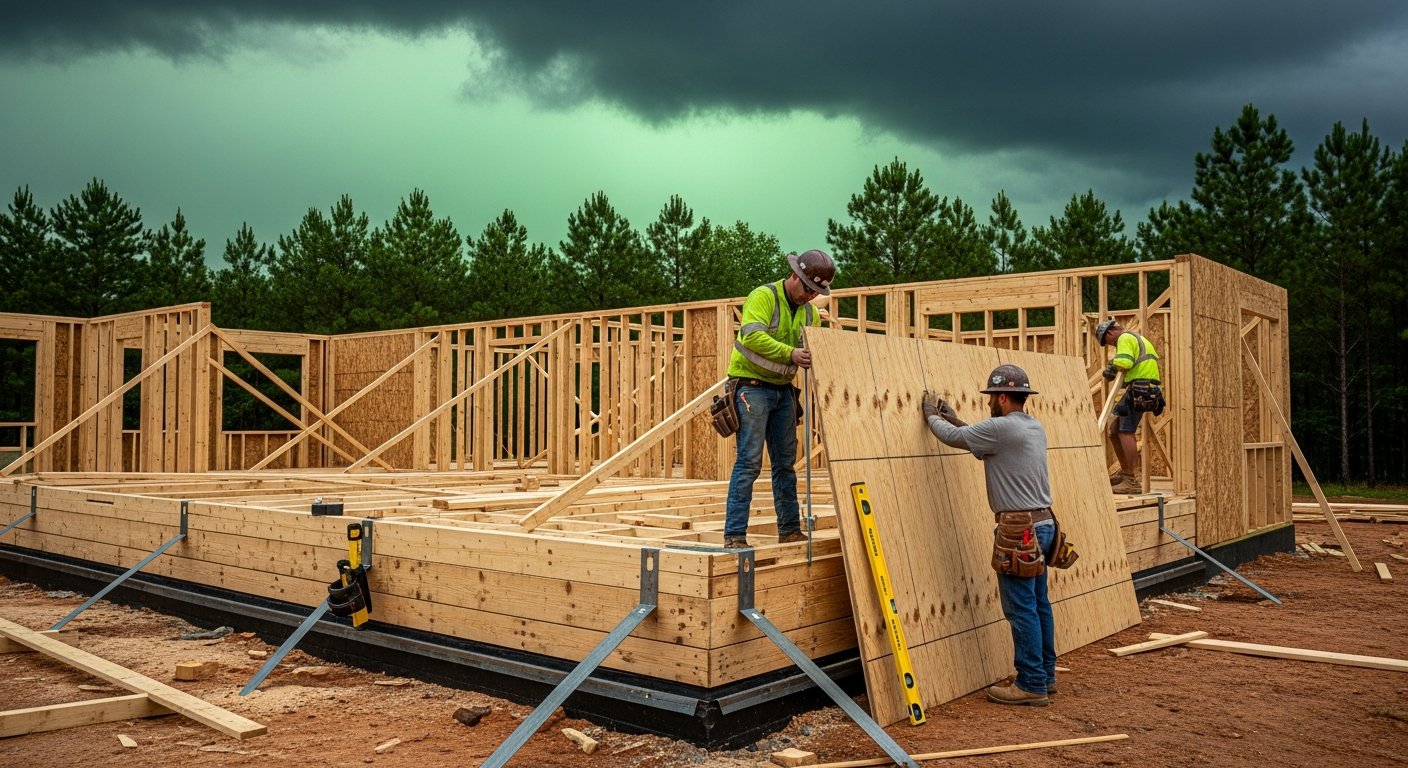
- Impact-resistant sheathing: Plywood or oriented strand board (OSB) with thicker dimensions and tighter nailing patterns prevents walls from racking (twisting) under wind pressure.
- Hurricane clips and straps: These galvanized metal connectors secure rafters and trusses to the wall framing, preventing roof lift-off during high winds.
- Reinforced gable ends: Gable end walls are particularly vulnerable. Adding structural sheathing, extra fasteners, and even steel bracing significantly improves their performance.
- Secondary water barriers: Flexible flashing and self-adhered membranes behind siding and roofing provide a backup defense if the primary cladding is breached.
Each of these techniques works best when integrated into the overall design rather than added as an afterthought. A qualified contractor will plan the load path from the foundation up, ensuring that every link in the chain is equally strong.
Continuous Load Path: The Backbone of Storm Resistance
Think of a continuous load path as a heavy chain that runs from the roof ridge down to the concrete footing. Each link must be strong enough to handle the force that passes through it. In a conventional home, the roof is often just nailed to the wall top plates. Under high uplift pressure, those nails can pull out. A storm resistant home uses metal hurricane ties or clips at every rafter or truss connection. These devices are rated to resist hundreds of pounds of uplift force.
At the wall-to-foundation connection, anchor bolts or epoxy-set anchors secure the bottom plate to the concrete slab or foundation wall. In areas with high wind exposure, these bolts are spaced closer together (typically 4 feet on center instead of 6 feet). The wall studs are then attached to the top and bottom plates with strong nails or structural screws. Finally, the roof framing is tied to the walls with the same type of metal connectors used for the rafters. When all these connections work together, the building behaves as a unified structure rather than a collection of loosely attached parts.
Impact-Resistant Sheathing and Nailing Patterns
Standard sheathing is often installed with nails spaced 12 inches apart on the edges and 6 inches in the field. For storm resistance, the nailing schedule changes to 6 inches on the edges and 6 inches in the field. This tighter pattern increases the shear strength of the wall dramatically. Additionally, using thicker sheathing (such as 7/16-inch OSB instead of 3/8-inch) adds stiffness and reduces the chance of fastener pull-through.
Some builders in Arkansas are now using zip system sheathing, which combines structural panels with a built-in water-resistive barrier. This eliminates the need for house wrap and provides a secondary seal against wind-driven rain. When a storm breaches the siding, the sheathing layer keeps water out of the wall cavity. This is especially important in Arkansas, where heavy rain often accompanies high winds.
Materials That Make a Difference
Choosing the right materials is just as important as the framing technique itself. Here are the materials that Arkansas contractors recommend for storm resistant construction.
- Galvanized steel connectors: Look for products from Simpson Strong-Tie or USP. These connectors resist corrosion and maintain their strength for decades.
- Structural screws: Screws have higher pull-out resistance than nails. Products like Simpson Strong-Drive screws are specifically designed for structural connections.
- Pressure-treated lumber: For any wood in contact with concrete or exposed to moisture, pressure-treated lumber resists rot and termite damage.
- Engineered wood products: LVL (laminated veneer lumber) and glulam beams are stronger and more dimensionally stable than solid lumber, especially for long spans in roof and wall framing.
- Impact-rated windows and doors: While not strictly framing, the connections around openings must be reinforced to prevent the entire assembly from blowing in.
Using these materials together with proper installation techniques creates a home that can withstand winds of 130 miles per hour or more, depending on the specific design. Many of these products are readily available at local lumber yards and building supply stores in Arkansas.
How to Work With a Contractor on Storm Resistant Framing
Not every builder has experience with storm resistant framing. When you are planning a new home or a major addition, it pays to hire a contractor who understands the local climate and building codes. Start by asking potential contractors about their experience with continuous load path design. A good contractor will be able to show you examples of connections, describe the specific products they use, and explain how they handle gable ends and roof-to-wall ties.
Ask for references from homeowners who have gone through a storm event. If possible, visit a project site where the framing is underway so you can see the connectors and nailing patterns firsthand. A reputable contractor will welcome the opportunity to demonstrate their quality. You can also check with the local building department to see if the contractor has a history of passing wind-resistance inspections.
If you are planning a remodel or addition in Batesville, working with a local company like The Real Deal of Batesville ensures that the team understands the specific weather patterns and code requirements of Independence County. Their experience with both new construction and remodeling projects means they can integrate storm resistant techniques into any scope of work, from a simple deck to a full home rebuild.
Connecting Storm Resistance to Overall Home Performance
Storm resistant framing does more than protect against high winds. It also improves the overall structural integrity of the home, which can reduce noise transmission, prevent floor squeaks, and even improve energy efficiency. When walls are built with tight sheathing and solid connections, air leaks are minimized. This reduces heating and cooling costs year-round.
In addition, many of the same techniques used for storm resistance also help with seismic resistance. While Arkansas is not as active as California, small earthquakes do occur in the region. A continuous load path helps the building respond to ground motion without collapsing. By investing in these framing methods, you get multiple layers of protection for a relatively small increase in construction cost.
Planning Your Storm Resistant Project
Whether you are building a new home or retrofitting an existing structure, the first step is a thorough assessment. Have a qualified contractor or structural engineer evaluate the current framing. Identify the weakest points, such as unbraced gable ends, missing hurricane clips, or insufficient anchor bolts. From there, develop a prioritized plan that addresses the most critical connections first.
For existing homes, retrofitting can be done in phases. Start with the roof-to-wall connections, as roof lift-off is the most common failure mode in high winds. Next, reinforce the wall-to-foundation anchors. Finally, upgrade the sheathing and nailing patterns on the most exposed walls. Many Arkansas homeowners find that a phased approach allows them to spread the cost over several years while still gaining meaningful protection.
If you are planning a deck or outdoor living space, remember that those structures also need storm resistant connections. Decks that are not properly attached can become projectiles during a storm. In our guide on Living Room Accent Wall Ideas Arkansas Homes Love, we highlight how interior and exterior upgrades work together to create a safer, more comfortable home.
Final Thoughts on Storm Resistant Framing
Storm resistant framing techniques Arkansas homes can use are not just for new construction. Many of the same methods can be applied to existing homes through targeted retrofits. The key is to focus on the connections: roof to walls, walls to foundation, and sheathing to framing. When these links are strong, the whole structure performs better under extreme stress. Working with a knowledgeable contractor who uses proven materials and techniques is the best way to ensure your home is ready for whatever weather comes your way. Investing in these upgrades now can save thousands of dollars in repairs and provide peace of mind for years to come.