Arkansas soil is unpredictable. One season of heavy rain can leave your yard sloping in ways that make a concrete pad project feel impossible. Whether you are planning a shed foundation, a patio, a hot tub base, or a driveway approach, the success of the entire pour depends on what happens before the truck arrives. Leveling uneven ground for concrete pad installation Arkansas projects is not just about aesthetics; it is about structural integrity, drainage, and long-term durability. A slab poured on unlevel soil will crack, settle, and shift within a few years, wasting your investment and creating safety hazards.
In this guide, we break down the process of preparing and leveling your site for a concrete pad in the Natural State. We cover soil assessment, excavation, base materials, compaction, and drainage strategies. We also explain why working with a local contractor who understands Arkansas clay and freeze-thaw cycles is the smartest decision you can make. If you are in Batesville or the surrounding areas, our team at The Real Deal Batesville has the experience and equipment to handle your site preparation from start to finish.
Why Ground Leveling Matters for Concrete Pads
Concrete is heavy, roughly 150 pounds per cubic foot. A standard 10 by 12 foot pad, four inches thick, weighs about 6,000 pounds. That weight needs uniform support across the entire surface. If the ground underneath is uneven, low spots will create voids where the concrete has no support. These voids become stress points. When a heavy vehicle, a hot tub, or even seasonal ground movement applies pressure, the concrete cracks along those unsupported areas.
Leveling uneven ground for concrete pad installation Arkansas also solves water problems. A properly sloped pad directs rainwater away from structures and toward drainage areas. If the ground is uneven and water pools under the pad, the soil becomes saturated. Arkansas clay expands when wet and shrinks when dry. This cycle, called shrink-swell behavior, is one of the leading causes of concrete failure in the state. A level, compacted base with proper drainage prevents this movement from reaching the slab.
Another reason leveling matters is the finished surface. A pad that looks flat but sits on a sloped base will not stay flat for long. The top surface will follow the settling of the soil beneath it. For AC units, generators, and sheds, an uneven surface puts stress on the equipment or the structure. For patios and walkways, it creates tripping hazards. Taking the time to level the ground correctly before pouring is the only way to guarantee a flat, stable, and safe final result.
Assessing Your Site Before You Start
The first step in any successful concrete project is a thorough site assessment. You cannot fix what you do not understand. Walk the area where you plan to pour and look for signs of existing drainage problems, soft spots, or steep slopes. Pay attention to how water moves across your yard during a rainstorm. That observation will tell you more about your leveling needs than any tool can.
Here are the key factors to evaluate before you begin leveling uneven ground for concrete pad installation Arkansas:
- Soil type: Arkansas has a mix of clay, silt, sand, and loam. Clay is the most challenging because it expands and contracts with moisture. Sandy soil drains well but may need more compaction.
- Slope direction: The pad should have a slight slope, usually 1 to 2 percent, away from any structure. The ground preparation must create this slope before the pour.
- Existing vegetation: Grass, roots, and organic material must be removed. Organic matter decomposes over time, leaving voids that cause the slab to settle.
- Utility lines: Contact your local utility companies to mark underground lines before any excavation. Striking a gas line or cable during leveling is dangerous and expensive.
- Access for equipment: Excavators and plate compactors need room to work. Consider how your contractor will get equipment to the site.
Once you have this information, you can decide whether the project is a simple DIY job or one that requires professional help. For small pads, like a 3 by 5 foot AC unit base, a homeowner with some tools might manage. For larger pads, or projects on a significant slope, the cost of renting equipment and the risk of getting the base wrong makes hiring a professional the better value.
Excavation: Removing the Unstable Material
After assessing the site, the next step is excavation. This process removes the topsoil and any organic material that cannot support the weight of the concrete. Topsoil is full of roots, grass, and decaying matter. It is not a stable base. You need to dig down to the mineral soil or the subsoil, which is denser and more predictable.
The depth of excavation depends on the climate and the intended use of the pad. For most residential projects in Arkansas, you will dig down at least 4 to 6 inches below the final grade of the pad. This depth allows room for a 4-inch concrete slab plus a 4 to 6-inch compacted gravel base. For heavier loads, like a driveway or a hot tub, you may need to go deeper, up to 8 or 10 inches of base material.
During excavation, it is critical to over-excavate the edges. The base material needs to extend slightly beyond the pad footprint to provide lateral support. If you dig only the exact size of the pad, the edges of the gravel base can crumble and wash away, leading to edge settlement. A good rule of thumb is to excavate at least 6 inches wider on all sides than the planned pad dimensions.
For leveling uneven ground for concrete pad installation Arkansas, the excavation step also involves cutting into slopes. If your site is on a hillside, you will need to create a stepped or terraced base to achieve a level surface. This is not a simple task. It requires understanding soil stability and proper benching techniques to prevent the hillside from sliding into your new pad. A professional contractor will know how to handle these slopes safely.
Building a Stable Base with Gravel and Fill
Once the excavation is complete, the next phase is building up the base. The base material is usually crushed stone or gravel. This layer serves several purposes. It drains water away from the slab, it distributes the load evenly, and it provides a stable platform for the concrete. Do not use sand or topsoil as fill material. Sand does not compact well and can shift under load. Topsoil is organic and will settle.
When selecting gravel, look for crushed stone with angular edges, such as #57 stone or road base. Angular pieces lock together when compacted, creating a solid matrix. Rounded river rock does not lock together and will move under pressure. The base layer should be placed in lifts, or layers, of about 4 inches. Each lift must be compacted before adding the next one. This step-by-step compaction is what prevents future settling.
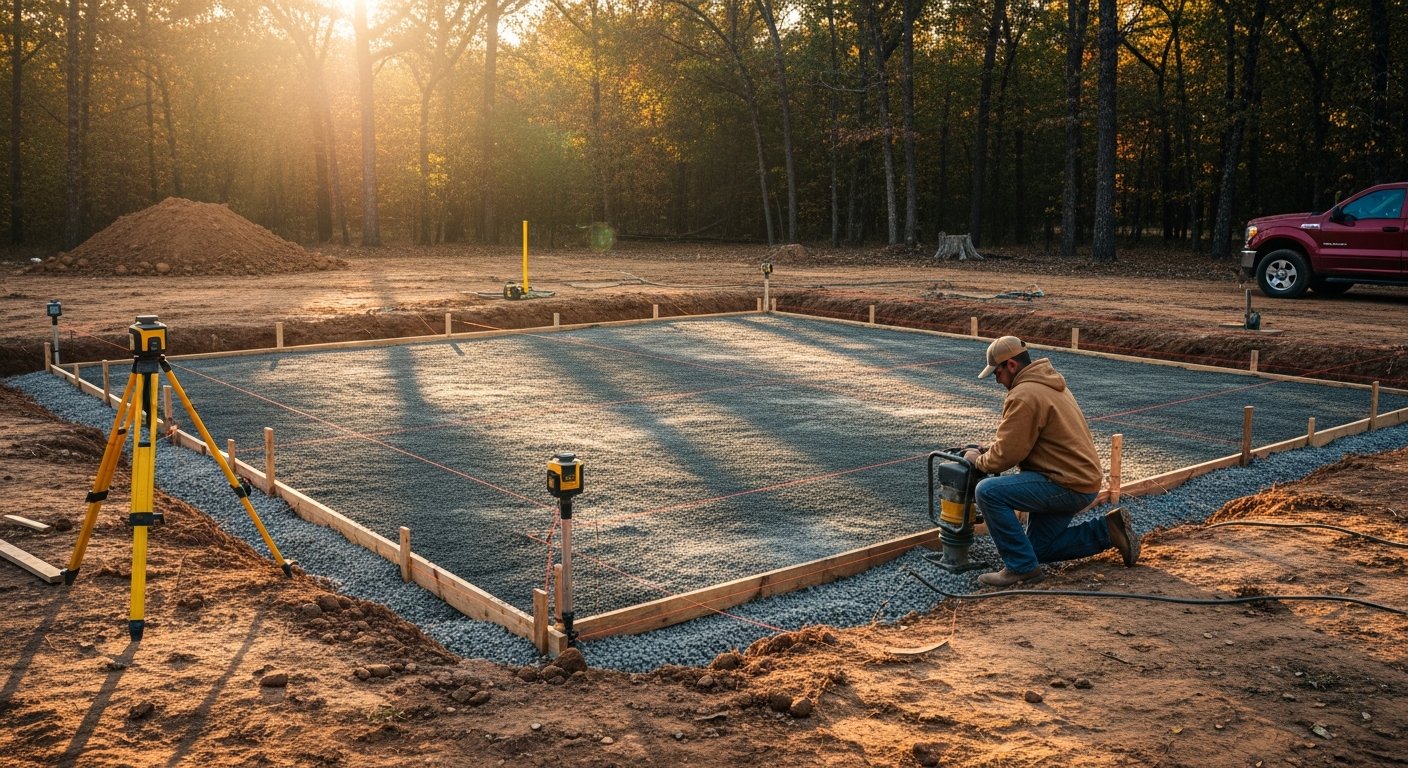
For leveling uneven ground for concrete pad installation Arkansas, the fill process is where you correct the elevation differences. You add gravel to the low spots and remove excess soil from the high spots. A laser level or a long straightedge and a string line are essential for checking your work. The goal is to have a surface that is level across the width but slopes gently in one direction for drainage. This is called a crown or a single-direction slope.
The thickness of the gravel base is not a place to cut corners. A thicker base of 6 to 8 inches is always better than a thinner one. It provides more stability and better drainage. The cost of a few extra tons of gravel is small compared to the cost of repairing a cracked slab later. Your contractor will calculate the exact amount needed based on the soil conditions and the load the pad will bear.
Compaction: The Step That Prevents Future Cracks
Compaction is the most critical part of the entire leveling process. It is also the step most often skipped or done incorrectly by DIYers. Compaction removes air pockets from the soil and gravel, making it dense and stable. Without proper compaction, the material will settle over time, creating voids under the concrete slab.
To compact the base properly, you need a plate compactor or a vibratory roller. These machines use vibration to settle the aggregate particles into a tight formation. For small projects, a walk-behind plate compactor is sufficient. For larger pads, a ride-on roller may be necessary. You should run the compactor over the entire surface in overlapping passes, at least two or three times, to ensure uniform density.
The soil underneath the gravel also needs compaction. If the excavation exposed loose soil, you must compact that first before adding gravel. This is especially important in areas with fill dirt. Fill dirt is notoriously unstable unless it is compacted in thin layers. A professional contractor knows how to test the compaction of the soil, often using a nuclear density gauge or a simple proctor test, to ensure it meets the requirements for the project.
When leveling uneven ground for concrete pad installation Arkansas, the interaction between soil and gravel is key. The gravel base must be compacted to a smooth, dense surface. Any footprints or ruts left in the gravel will telegraph through the concrete. After the final pass with the compactor, the surface should be so firm that walking on it leaves no visible marks. This is the standard you should expect from a professional installation.
Drainage Considerations for Arkansas Weather
Arkansas is no stranger to heavy rain and flash flooding. A concrete pad that does not account for water will fail. The leveling process is your first line of defense against water damage. The slope you create during leveling directs surface water away from the pad. But you also need to think about what happens to the water that soaks into the ground.
A gravel base acts as a French drain beneath the slab. Water that reaches the edge of the pad seeps down into the gravel and is carried away. For this to work, the gravel base must extend to the edge of the excavation and the surrounding soil must be lower than the base. If water can pool at the edge of the pad, it will eventually undermine the base. Creating a swale or a shallow ditch around the pad to channel water away is a smart addition.
For leveling uneven ground for concrete pad installation Arkansas, you also need to consider the water table. In low-lying areas, the water table can be close to the surface. If you excavate below the water table, you will have water seeping into your hole. This is a challenge that requires professional solutions, such as adding a sump pump or installing drainage tile. A contractor with local experience will know the high-water areas of Batesville and Independence County and can plan accordingly.
The goal is to keep the soil under the pad as dry as possible. Dry soil is stable soil. Wet soil expands, shifts, and loses its load-bearing capacity. By combining a proper slope, a gravel base, and surrounding drainage features, you create an environment where the concrete can perform as intended for decades.
Forms and Edge Support
Once the base is leveled and compacted, the next step before pouring is setting up the forms. Forms are the wooden or metal frames that hold the concrete in place while it cures. They also define the exact shape and dimensions of the pad. The top of the forms determines the final level of the concrete surface, so they must be set with extreme precision.
The forms are staked into the ground and adjusted until they are level, or until they match the intended slope. This is the last opportunity to correct any minor imperfections in the base. A small gap between the bottom of the form and the gravel base will allow concrete to leak out during the pour. This gap should be sealed with soil or a gravel product to prevent a mess and a weak edge.
For heavier applications, the edges of the pad may need additional support. This can be in the form of a thickened edge, where the concrete is poured deeper along the perimeter. This thickened edge acts as a beam, distributing the load more effectively. It is a standard practice for driveways and pads that will support significant weight. When leveling uneven ground for concrete pad installation Arkansas, the form setup must account for this thickened edge by excavating slightly deeper around the perimeter.
Reinforcement is also placed inside the forms before the pour. This is typically rebar or wire mesh. The reinforcement is not a substitute for a solid base; it simply helps hold the concrete together if the base does shift. The reinforcement must be lifted off the ground, usually with small plastic chairs, so it sits in the middle of the slab where it can do the most good. Setting the forms and reinforcement correctly is a skill that ensures the pad looks right and lasts long.
Pouring and Finishing the Concrete
With the forms set and the base ready, the concrete pour can begin. This is the moment when all the preparation pays off. The concrete is delivered by a ready-mix truck and placed into the forms. For larger pads, the truck can chute the concrete directly into place. For smaller or distant areas, a pump truck may be necessary to move the concrete from the truck to the forms.
Once the concrete is in the forms, it needs to be spread and leveled. This is done using a screed, which is a long straight board or a powered screed that is pulled across the top of the forms. The screed removes excess concrete and fills low spots, creating a flat, even surface. This initial leveling is called screeding. It is followed by floating, which smooths the surface and brings the fine aggregate to the top.
The finishing process is a craft. The concrete must be worked at the right time, when it is neither too wet nor too dry. Overworking the surface can weaken it and cause dusting. Underworking can leave it rough and uneven. For a pad that will be hidden, like a shed foundation, a basic broom finish is ideal. It provides traction and is quick to apply. For a patio or walkway, a smoother finish might be desired, but it should still have some texture for safety.
After the finish is applied, the concrete must be cured. Curing is the process of keeping the concrete moist and at a stable temperature for several days. This allows the chemical reaction that hardens the concrete to occur properly. In the Arkansas summer, this means covering the concrete with wet burlap or a curing compound to prevent it from drying out too quickly. In the winter, it means protecting it from freezing. Proper curing is essential for the concrete to reach its full strength.
Working with a Professional Contractor in Batesville
Leveling uneven ground for concrete pad installation Arkansas is a demanding job that requires the right tools, knowledge, and experience. While it is possible to do a small pad yourself, the risk of making a mistake that leads to cracking or settling is high. The cost of renting a plate compactor, buying gravel, and dealing with disposal of excavated soil can quickly add up. And if you get the base wrong, you will be paying for the repair or replacement much sooner than you think.
Hiring a professional contractor like The Real Deal Batesville takes the guesswork out of the process. We have the expertise to assess your soil, design the correct base, and execute the leveling and pouring with precision. We also have the equipment, from excavators to laser levels, to get the job done efficiently. Our team understands local building codes and permitting requirements, ensuring your project is compliant and safe.
When you work with us, you are not just paying for labor. You are paying for peace of mind. We stand behind our work and we understand what it takes to make a concrete pad that lasts in the Arkansas climate. We handle the entire process, from the initial consultation to the final cleanup. For more detailed guidance on specific installations, check out our AC unit concrete pad installation guide Arkansas for related tips and best practices.
Before you start digging, consider the long-term value of a professional installation. A properly leveled and poured concrete pad will serve you for 30 years or more. It is an investment in your property that should be done right the first time. Contact us at The Real Deal Batesville to discuss your project and get a free estimate. Let us put our expertise to work for you.
In conclusion, the key to a successful concrete pad is not the concrete itself, but the ground beneath it. Taking the time to properly level uneven ground for concrete pad installation Arkansas will save you money, time, and frustration in the long run. From assessing the soil to compacting the base and ensuring proper drainage, every step matters. With the right preparation and a trusted local contractor, your concrete pad will be a durable, functional addition to your home for decades to come.