A kitchen that looks beautiful in photographs but feels flat and uninviting in person is often missing one critical element: thoughtful lighting. Many homeowners focus on cabinets, countertops, and backsplashes, yet overlook the power of a well-planned lighting scheme. The truth is that how you light your kitchen determines how the space functions for cooking, how it feels for gathering, and how it showcases your design choices. In Batesville, where kitchens serve as the heart of family life and entertaining, getting this right transforms a room from merely functional to truly exceptional. Understanding kitchen lighting design layering function ambiance Batesville requires a strategic approach that balances task performance with atmospheric warmth.
Why Layering Matters in Kitchen Lighting
A single overhead fixture, no matter how stylish, cannot meet all the needs of a busy kitchen. You need bright, shadow-free light for chopping vegetables and reading recipes. You need softer light for casual meals and conversation. You need accent light to highlight a beautiful tile backsplash or a collection of cookbooks. Layering solves these competing demands by combining three distinct types of lighting: ambient, task, and accent. Each layer serves a specific purpose, and together they create a flexible system that adapts to any activity or mood.
When you approach kitchen lighting design layering function ambiance Batesville with this layered mindset, you avoid the common pitfalls of glare, dark corners, and harsh shadows. The result is a kitchen that feels larger, safer, and more inviting. For homeowners working with a local remodeling team, discussing these layers early in the planning process ensures that wiring, switch placement, and fixture selection align perfectly with your daily routines.
Ambient Lighting: The Foundation of Your Kitchen
Ambient lighting provides the general illumination that fills the room. It is the base layer that allows you to move safely through the space and see the overall layout. In most kitchens, ambient light comes from ceiling-mounted fixtures, recessed cans, or a central flush-mount light. The key is to distribute this light evenly so there are no pools of darkness or overly bright spots.
For Batesville kitchens with standard eight-foot ceilings, recessed LED lights spaced four to five feet apart deliver clean, uniform ambient light. If your kitchen has higher ceilings, consider pendant lights or a statement chandelier that also contributes to the ambient layer. Dimmer switches are essential here: they let you adjust the ambient level from bright and energetic for meal prep to soft and subdued for a late-night snack or a glass of wine with friends.
When planning your ambient layer, think about the natural light your kitchen receives. South-facing windows in Arkansas homes can flood the space with daylight, reducing the need for artificial ambient light during the day. North-facing windows may require more consistent supplemental light. Your remodeling contractor can help you evaluate your kitchen’s orientation and recommend fixture placements that complement natural light rather than compete with it.
Task Lighting: Precision Where You Need It
Task lighting is the focused illumination that makes specific work areas safe and efficient. Without it, you end up leaning over the counter to see what you are cutting, or cooking in your own shadow. The three primary task zones in any kitchen are the countertop prep area, the stove and cooktop, and the sink. Each requires its own dedicated light source.
Under-cabinet lighting is the most effective solution for countertop tasks. LED strip lights or puck lights mounted beneath upper cabinets eliminate shadows and cast light directly onto the work surface. Choose fixtures with a color temperature around 3000K to 3500K, which provides a clean white light without feeling clinical. For the cooktop, a range hood with integrated lights or a narrow pendant hung 30 to 36 inches above the surface ensures you can see what is simmering and browning.
Task lighting should be controlled separately from your ambient layer. This allows you to switch off the general lights while keeping task lights on, saving energy and reducing glare when you are working alone. In Batesville kitchens where families gather to cook together, having multiple task zones with independent controls lets everyone work comfortably without interfering with each other’s light.
Accent Lighting: Adding Depth and Personality
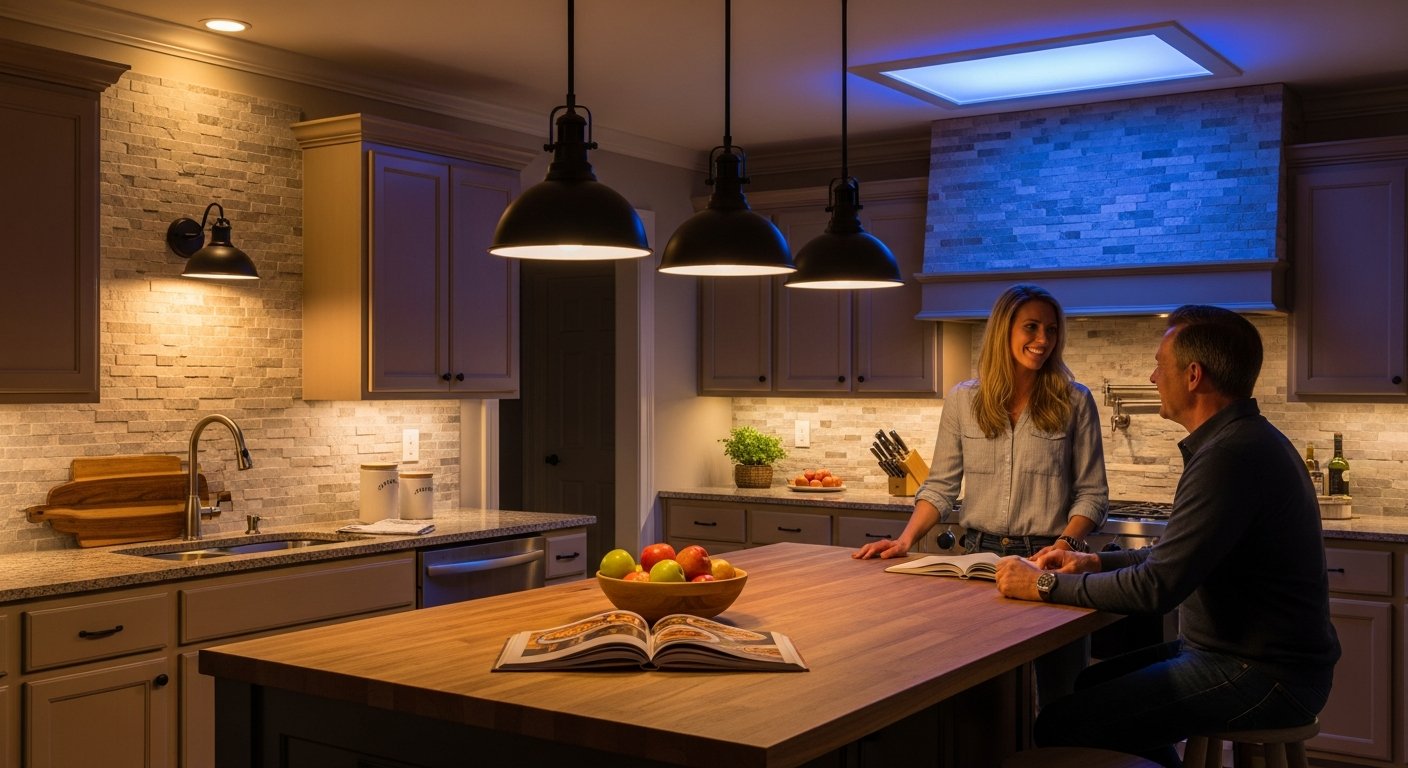
Accent lighting is the layer that elevates your kitchen from practical to personal. It draws the eye to architectural features, decorative elements, and textures that might otherwise go unnoticed. A well-placed accent light can make a simple white subway tile backsplash look rich and dimensional, or turn an open shelving display into a gallery-worthy vignette.
Consider these accent lighting opportunities in your kitchen:
- Toe-kick lighting along the base of cabinets creates a floating effect that adds modern sophistication and provides a soft nightlight for late-night trips to the kitchen.
- In-cabinet lighting for glass-front upper cabinets showcases your favorite dishes and glassware while adding depth to the room.
- Adjustable track heads or picture lights aimed at a textured backsplash, a piece of art, or a decorative hood vent create visual interest and a sense of luxury.
- LED strips installed on top of cabinets cast a warm glow upward, drawing the eye to the ceiling and making the room feel taller.
When incorporating accent lighting into your kitchen lighting design layering function ambiance Batesville, use separate switches or smart controls so you can turn accent lights on independently. This gives you the ability to set a romantic dinner mood, a lively party atmosphere, or a calm early-morning environment with the touch of a button.
Choosing the Right Fixtures and Bulbs
The fixtures you select carry both functional and aesthetic weight. Pendants over an island should hang low enough to provide task light but high enough to not obstruct sightlines. Typically, 30 to 36 inches above the counter surface works well. Recessed lights should be placed with care to avoid casting shadows from your own head onto the work surface. A common rule is to install recessed lights 12 to 18 inches in front of upper cabinets, not directly above them.
Bulb selection matters as much as fixture placement. Color temperature, measured in Kelvin (K), determines whether the light feels warm or cool. For kitchens, a mix of 2700K to 3000K for ambient and accent layers creates a welcoming feel, while 3500K for task areas provides crisp visibility without being harsh. LED bulbs are the standard choice today because they last for years, use minimal electricity, and produce very little heat, which is especially welcome during hot Arkansas summers.
Dimmability is a feature you should not skip. Insist on dimmable LED bulbs and dimmer switches that are compatible with them. This simple upgrade gives you total control over the intensity of each layer, allowing you to transition from bright cooking mode to soft entertaining mode in seconds.
Putting It All Together: A Batesville Kitchen Example
Imagine a typical Batesville kitchen remodel: a 12 by 14 foot L-shaped layout with a central island. The ambient layer consists of six recessed LED lights on a dimmer, positioned to avoid shadows at the perimeter counters. Over the island, two large pendant lights with clear glass shades provide both ambient contribution and task light for the island workspace. Under the upper cabinets, continuous LED strip lights illuminate the countertops with a warm white glow. Inside the glass-front cabinets flanking the range, small puck lights highlight the homeowner’s collection of pottery. Finally, a slim LED strip runs along the toe-kick of the island, creating a subtle floating effect that makes the room feel larger at night.
This combination of layers means the family can cook dinner with bright task lights, then dim everything except the toe-kick and cabinet lights for a quiet evening. When guests arrive, all layers come on at full brightness to show off the new quartz countertops and custom backsplash. The system is flexible, energy-efficient, and tailored to how the homeowners actually live.
For those exploring a full kitchen renovation in the Batesville area, working with a contractor who understands layered lighting is essential. In our guide on planning a Batesville kitchen renovation, we discuss how lighting integration during the design phase prevents costly rewiring later and ensures every fixture has a purpose.
Smart Controls and Automation
Modern lighting control systems take layering to the next level. Smart dimmers, scene controllers, and voice-activated assistants let you recall your favorite lighting scenes with a tap or a spoken command. You can program a “cooking” scene that sets task lights to 100 percent and ambient lights to 70 percent, a “dinner” scene that lowers ambient to 40 percent and turns on accent lights, and a “cleaning” scene that brings everything to full brightness.
For Batesville homeowners who value convenience, smart lighting also integrates with other home systems. Lights can be set to turn on automatically when you enter the kitchen in the morning, or to dim gradually in the evening to support your natural sleep cycle. These features are not just about luxury; they improve energy efficiency by ensuring lights are only on when needed and at the appropriate level.
When planning your lighting controls, wire each layer to a separate switch or dimmer at the entry point. This gives you manual control even if you choose to add smart features later. Your electrician can install neutral wires in every switch box, which is required for most smart dimmers and makes future upgrades straightforward.
The final piece of the puzzle is considering how your kitchen lighting interacts with adjacent rooms. An open-concept kitchen that flows into a dining or living area should have a cohesive lighting plan. Use similar color temperatures and dimming capabilities so the transition between spaces feels seamless. This is especially important in Batesville homes where the kitchen often opens to a great room or breakfast nook.
Good kitchen lighting is not an afterthought. It is a deliberate system of layers that work together to support every activity, highlight your design investments, and create the atmosphere you want. By investing time in planning your kitchen lighting design layering function ambiance Batesville, you ensure that your kitchen is not just a place to cook, but a space where your family and friends truly love to gather.