If you work from home in Arkansas, you know the struggle of background noise during a conference call. The neighbor’s dog, the lawnmower down the street, or the TV in the next room can all disrupt your focus. The good news is that you do not need to move or build a separate structure to get a quiet workspace. With the right soundproofing drywall techniques for home offices in Arkansas, you can transform an ordinary room into a professional, distraction-free zone. This approach combines specialized building materials and proven installation methods to block airborne noise and reduce vibration. Whether you are converting a spare bedroom or finishing a basement, these strategies will help you reclaim your peace and quiet.
Why Standard Drywall Falls Short for Noise Control
Standard half-inch drywall is the most common wall finish in American homes, but it offers very little soundproofing. Sound waves pass through it almost as easily as light passes through a window. When you consider the typical wood-frame construction used in most Arkansas homes, the problem becomes clear. Sound travels through the drywall, then through the air gap in the wall cavity, and then through the drywall on the other side. This means a normal conversation in the next room can be clearly heard in your home office.
The physics of sound transmission is measured by a rating called STC (Sound Transmission Class). A standard interior wall with single-layer drywall on each side typically rates around STC 30 to 33. For a home office where you need privacy and quiet, you want an STC rating of at least 50. Achieving that level of performance requires specific soundproofing drywall techniques for home offices in Arkansas. These techniques add mass, decouple surfaces, and seal air gaps. Without them, you are essentially working in a fishbowl where every sound escapes and every outside noise enters.
Mass-Loaded Vinyl: The Heavyweight Champion
One of the most effective ways to block sound is to add mass to your walls. Mass-loaded vinyl (MLV) is a dense, flexible material that acts as a sound barrier. It is typically sold in rolls and can be installed between layers of drywall or directly over existing drywall before adding a new finish layer. For homeowners looking for soundproofing drywall techniques for home offices in Arkansas, MLV is a practical choice because it does not require major structural changes.
To install MLV, you attach it to the studs using acoustical caulk and fasteners. Then you cover it with a second layer of drywall. This creates a mass sandwich that is very effective at stopping airborne noise such as voices, music, and TV sounds. The key is to overlap the seams by at least two inches and seal every edge with acoustical caulk. Even a tiny gap can reduce the barrier’s effectiveness by 50 percent or more. When combined with other techniques, MLV can push your wall assembly to an STC rating above 55.
Green Glue: Damping Vibration Between Layers
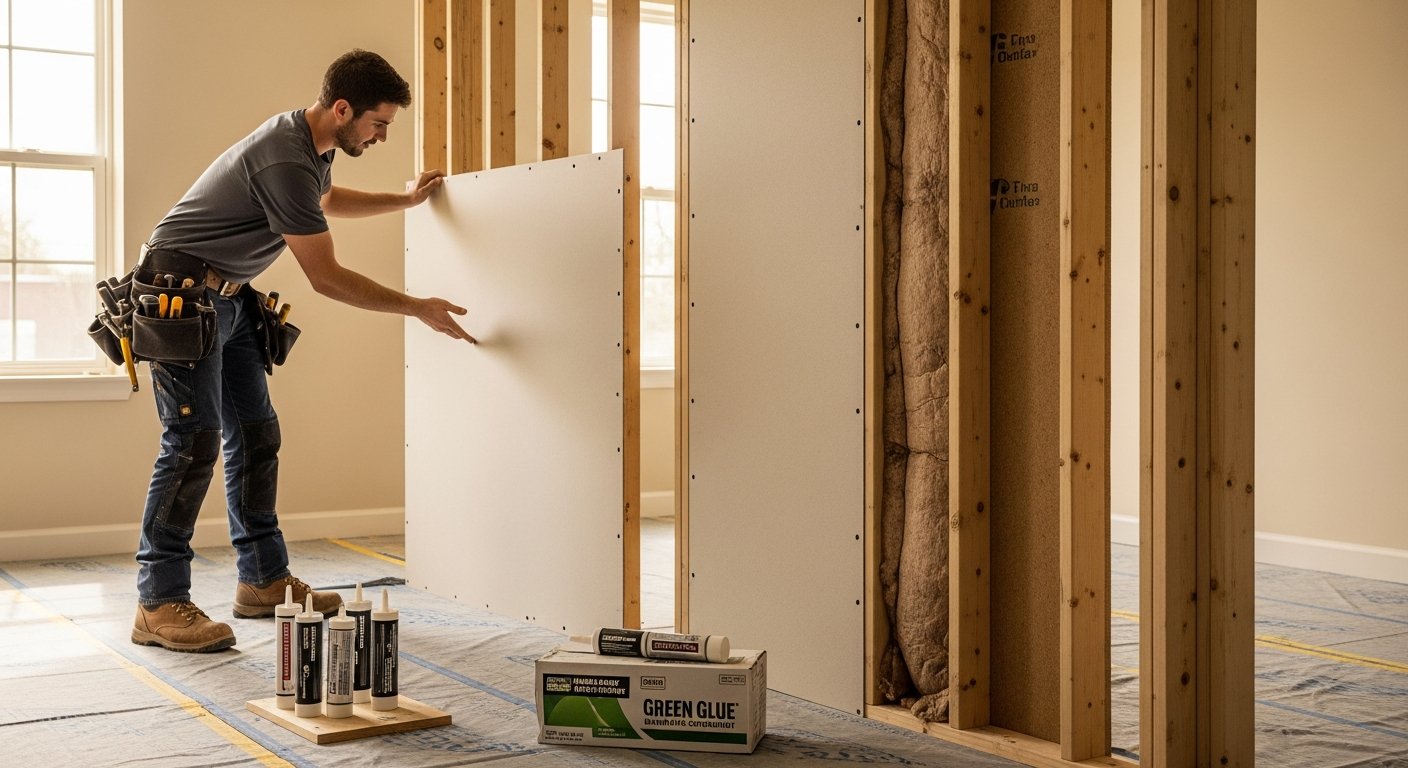
While mass blocks sound, damping materials like Green Glue convert sound energy into a small amount of heat. This product is a viscoelastic compound that stays permanently flexible. You apply it between two rigid panels such as two layers of drywall or between drywall and MLV. When sound waves hit the assembly, the two panels vibrate at different rates, and the damping compound absorbs that motion.
For a home office in Arkansas, using Green Glue between two layers of five-eighths-inch drywall can improve STC ratings by 10 to 15 points over a single layer. The application process is simple. You run a bead of Green Glue around the perimeter of the drywall sheet and then apply a random zigzag pattern across the field. Then you screw the second layer to the first, but not into the studs. This allows the two panels to work independently and maximizes the damping effect. This technique is a core part of any serious soundproofing drywall approach for home offices in Arkansas.
Resilient Channels: Decoupling for Maximum Isolation
Decoupling is the practice of separating the drywall from the studs so that sound vibrations cannot easily travel from one side of the wall to the other. Resilient channels are metal strips that create this separation. They are attached horizontally to the studs, and then the drywall is screwed into the channels instead of directly into the studs. This breaks the direct mechanical connection that normally carries sound through a wall.
When using resilient channels, you must follow specific installation rules. Do not let the drywall screws touch the studs. Keep the channels at least one inch away from the top and bottom plates. And never install the channels on both sides of the same stud cavity because that can short-circuit the isolation. This method works exceptionally well for blocking low-frequency sounds like traffic noise or a subwoofer. For Arkansas homeowners who live near busy roads or have home theaters near their office, resilient channels are a game changer among soundproofing drywall techniques for home offices in Arkansas.
Acoustic Caulk and Putty Pads: Sealing Every Leak
Even the most carefully constructed wall will fail if it has air gaps. Sound behaves like a fluid. It will find and exploit the smallest crack or hole. Acoustic caulk is a non-hardening sealant that remains flexible for years. You use it to seal the perimeter of every drywall sheet, around electrical boxes, and along baseboards. Unlike standard caulk, acoustic caulk does not dry out or crack, so it maintains its seal permanently.
Putty pads are another important tool. These are pre-formed pads made of a dense, pliable material that you install behind electrical outlets and switch plates. They block sound that would otherwise travel through the small gaps in the electrical box. You simply cut a slit for the wires and press the pad into place before installing the cover plate. Together with acoustic caulk, these sealants ensure that your soundproofing assembly performs as designed. No matter which soundproofing drywall techniques for home offices in Arkansas you use, sealing is the step that cannot be skipped.
Soundproofing the Ceiling and Floor
Walls are not the only path for noise. Sound also travels through the ceiling and floor, especially in multi-story homes or rooms with shared attics. For a home office located directly below a bedroom or above a garage, you need to address these surfaces as well. The same principles of mass, damping, and decoupling apply. You can install a second layer of drywall with Green Glue on the ceiling, or use resilient channels to hang the ceiling drywall.
For floors, adding a thick carpet with a high-density pad can significantly reduce impact noise like footsteps. If you have hardwood or tile floors in the room above your office, consider adding a layer of soundproofing underlayment beneath a new carpet. This can reduce the sound of walking by as much as 50 percent. When you combine these floor and ceiling treatments with the wall techniques described above, you create a complete soundproofing envelope. This holistic approach is what makes soundproofing drywall techniques for home offices in Arkansas truly effective.
Step-by-Step: Building a Soundproof Office Wall
For a practical example, here is how you might build a soundproof wall from scratch in an Arkansas home. This method works whether you are doing new construction or a major remodel.
- Frame the wall with standard 2×4 studs spaced 16 inches on center.
- Fill the wall cavity with R-13 or R-15 fiberglass insulation. Do not use paper-faced insulation because the paper can create a rigid connection. Unfaced insulation is better for sound absorption.
- Install resilient channels horizontally across the studs on one side of the wall. Use the manufacturer’s recommended fasteners.
- Install the first layer of drywall into the resilient channels using drywall screws that are short enough to avoid touching the studs.
- Apply Green Glue in a random pattern to the face of the first drywall layer.
- Install the second layer of drywall over the Green Glue, screwing it into the first layer only. Do not extend screws into the resilient channels or studs.
- Seal all perimeter edges with acoustic caulk. Use putty pads behind every electrical box.
- For the opposite side of the wall, repeat the process but do not use resilient channels. Instead, attach the first drywall layer directly to the studs, apply Green Glue, and add the second layer.
This dual-layer approach with decoupling on one side and mass on the other can achieve an STC rating of 55 or higher. That is enough to block normal conversation and most household noise. If you are planning a renovation and want professional results, consider working with a local contractor who understands these techniques. In our guide on hiring Arkansas renovation specialists, we explain how to find a team that can execute this level of detail.
Budget Considerations for Arkansas Homeowners
Soundproofing a room is an investment, but it does not have to break the bank. The most expensive option is to hire a contractor to do everything from framing to finishing. A more budget-friendly approach is to handle the sealing and insulation yourself and then bring in a drywall professional for the finishing work. Many Arkansas homeowners choose to soundproof one wall at a time, starting with the wall that faces the noisiest part of the house.
Here is a rough breakdown of material costs for a typical 10×12 foot wall:
- Two layers of five-eighths-inch drywall: approximately 60 to 80 dollars.
- Green Glue damping compound: about 40 to 50 dollars per tube, and you may need two tubes.
- Resilient channels: roughly 1 dollar per linear foot, so about 20 to 30 dollars.
- Acoustic caulk and putty pads: 25 to 40 dollars total.
- Insulation: 30 to 50 dollars.
That puts material costs for a single wall at around 200 to 300 dollars. If you hire a contractor, labor can double or triple that amount. However, the peace and quiet you gain can boost your productivity and even increase your home’s resale value. Many buyers in Arkansas look for homes with dedicated office space that is already soundproofed.
Common Mistakes to Avoid
One frequent error is using standard acoustic foam panels on the walls. These panels are designed to reduce echo and improve sound quality within a room, but they do almost nothing to stop sound from passing through the wall. They are not a substitute for mass or decoupling. Another mistake is failing to seal the bottom of the wall where it meets the floor. Sound can travel through that gap and bypass all your other work. Always use acoustic caulk along the bottom plate.
Another issue is flanking paths. Sound can travel over a wall if the ceiling is a drop ceiling or if there is a shared attic space above the office. In that case, you need to extend your soundproofing up to the roof deck or install a soundproof ceiling. Similarly, if the office shares a ductwork system with the rest of the house, noise can travel through the vents. Sealing ducts and adding sound baffles can help. Avoiding these pitfalls ensures that your soundproofing drywall techniques for home offices in Arkansas deliver the quiet you need.
Creating a quiet home office in Arkansas is not just about buying the right materials. It is about understanding how sound behaves and using proven construction methods to control it. By adding mass, damping vibration, decoupling surfaces, and sealing every gap, you can build a workspace that supports focus and professionalism. Whether you tackle the project yourself or hire a local expert, the result will be a room where you can work without distraction. Start with one wall, test the results, and expand as your budget allows. Your ears and your productivity will thank you.